
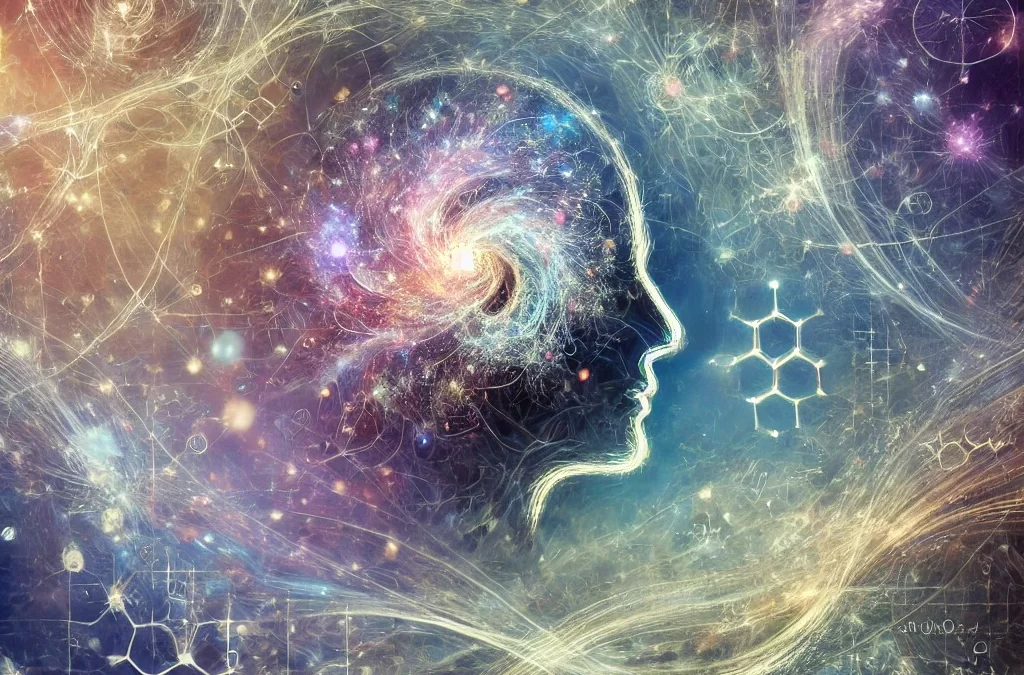
Quantum Irrationality: Rethinking Logic in the Age of Uncertainty
Have you ever wondered why some decisions feel “right,” even when they don’t make sense? There’s a kind of messiness to how we navigate choices—something that defies logic but still feels grounded in something real. It makes me curious: could our so-called irrationality be connected to the deeper structures of the universe, maybe even to the principles of quantum mechanics?
This isn’t a conclusion, and it isn’t trying to argue for a single perspective. It feels more like stepping into a question—an exploration of things we’ve seen, read, tasted, heard, experienced, maybe even imagined. Quantum mechanics seems to hold space for uncertainty in a way that feels strangely familiar when we think about human thought and behavior. Could there be connections here, or maybe echoes of something shared? And if so, what might they suggest—not about answers.
Rationality’s Uncertain Edges
Classical logic gives us clean, predictable frameworks—cause and effect, clear rules, tidy outcomes. But human behavior doesn’t often follow those patterns. Economists call it “irrational,” psychologists blame our cognitive biases. Still, I wonder if those labels miss something essential.
Quantum mechanics offers a different perspective. It describes a universe that isn’t linear or deterministic, but one that operates on probabilities, overlaps, and connections we can’t always see. Do our minds, too, reflect this kind of non-linear logic? Not in a literal sense, perhaps, but as a metaphor—or maybe something more.
The Superposition of Choices
In quantum theory, particles exist in multiple states at once until they’re observed. Light can be a wave and a particle at the same time. And only when you see it through your conscious eyes, does it appear to have a single physical property.
This idea of superposition makes me think of those moments where every option feels simultaneously real, equally possible.
Lets Say You’re deciding whether to leave your job, or stay in a relationship, or maybe what to say in a tough conversation. Each choice for that scenario feels alive in your mind, as though it’s already happening in some way. It can’t be defined as indecision—it’s something richer, maybe even necessary, I’m not sure.
Maybe we’re processing these possibilities, holding them all at once, until something—an outside force, a shift in perspective, someone’s wise words, or just time—collapses them into a single path?
I guess that’s why big decisions feel so weighty you know. It’s not the choice itself, but the feeling of all those other realities slipping away as you commit to one, is what it is.
You want to hold on to all those realities at the same time. And you really do in your mind. And all those realities do exist, in your mind.
Entangled Emotions
Quantum Entanglement is also very crazy—the way two particles, once connected, remain intertwined, no matter how far apart they are. Their states influence one another instantly, across vast distances.
It’s strange, almost poetic. Have you watched Interstellar? – In that movie, the makers have defined this hidden mechanism as love.
Have you ever felt someone’s joy or sadness as though it were your own, even if they’re miles away? Or found yourself inexplicably drawn into someone else’s mood, like their emotional state reaches across the air and pulls you in? When a person walks in, and has the ability to change your mood, just with presence, how is that rational?
It might not be entanglement in the quantum sense, but there’s something about these connections that feels just as profound and intuitive, mysterious alike, but familiar. What if the way we’re linked to others is more than chance, more than biology—something deeper, or stranger, something we can’t see and can’t consciously feel, can’t observe but still very powerful or simply unknown? If any of this were true, my God this life would be so much more cooler than how mind blowingly super cool it already is.
A Probabilistic Kind of Logic
Quantum mechanics is all about probabilities, where outcomes exist in a state of potential until something acts on them.
You think our minds also follow suit?
What if our seemingly “irrational” decisions are less about following rules and more about exploring these said potentialities?
Say when you acted on impulse, or intuition, or even fear. It didn’t follow logic, but it made sense in its own way. Maybe these choices arise from a probabilistic process—one shaped by context, emotions, and the way we perceive the world around us?
Not a flaw, but a feature, allowing us to adapt to uncertainty in ways classical logic never could.
The point of logic itself comes on facing uncertainty. Making more uncertain things certain. Shifting from subconcious to conscious. So that we do not act out of fear. Because we are destined to be smarter than beings that have a lesser conscious ability. To not be only subjected to flight or fight responses.
Quantum Cognition: An Open Question
There’s been some fascinating research into quantum cognition—this idea that our thought processes might mirror quantum systems in how they deal with probabilities, interference, and context. It’s far from a settled theory, but it raises questions worth asking. Could the way we think and decide reflect quantum principles, even loosely? Or is this just a metaphor, a way to make sense of the complexity of our minds?
I don’t know. And maybe it’s not an either-or. Perhaps quantum mechanics gives us a language to talk about uncertainty—a framework or a fabric that feels closer to the reality of human thought than the structures or rather when structures become shackles of classical logic.
Possibilities, Not Answers
The more I think about it, the more I’d want to get into the depth of neuroscience and how our brains work and how our neurons fire and why do they fire the way that they fire. Maybe the point is to notice—to see the unpredictability of our choices mirroring the unpredictability of the universe itself.
This might be about quantum mechanics, or it might be about how we see ourselves. It could be a way of making sense of irrationality, or it might be pointing to something entirely different. What if it’s both? Or neither? Or something else we haven’t considered yet?
Closing Thoughts
I don’t know if irrationality has anything to do with quantum mechanics. It’s not about finding certainty, and it’s not about solving the puzzle.
Tomorrow, or whenever next, when someone tells you that your decisions don’t make sense, maybe you can smile with gratitude.
Not because they’re wrong, and not because you’re right, or you think you’re right, but there’s something deeply & intuitively human in that uncertainty.
Something worth wondering about.
Something worth leaving unresolved.